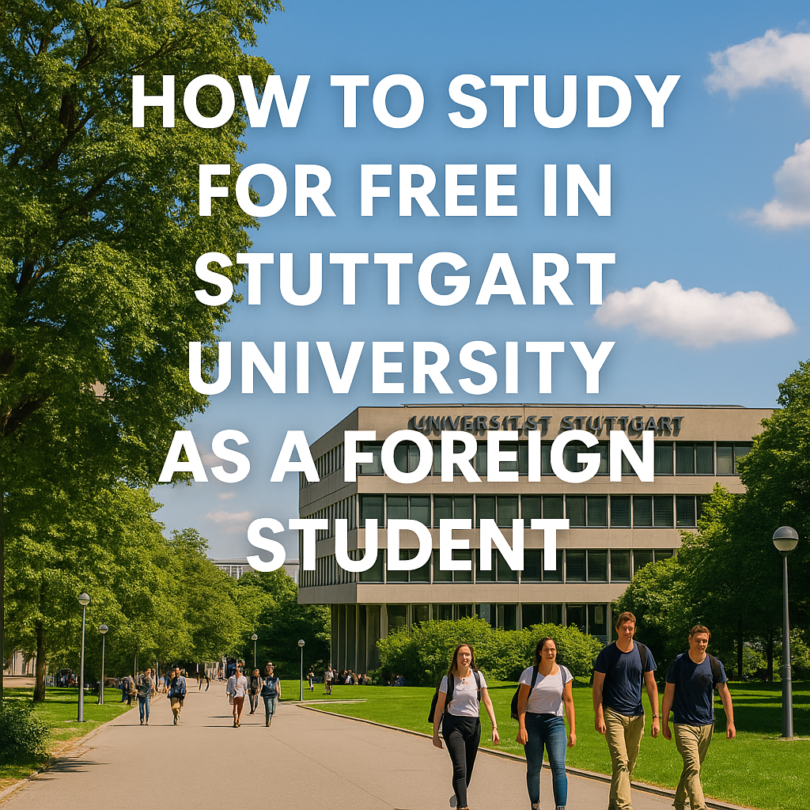

“Does free education in Germany actually exist?” And more specifically, in Stuttgart? Short answer: Yes. Long answer? Well… let’s talk.
Studying in Stuttgart, especially as an international student, doesn’t have to mean draining your savings or surviving on instant noodles (though you might still develop an oddly emotional relationship with them).
If you’re smart about it and a little patient you can actually pull this off with minimal cost and maximum experience.
Here’s the whole truth, broken down naturally and honestly.
Stuttgart? Seriously, Why There?
First off, why Stuttgart? It’s not just another city in Germany it’s the heart of Germany’s engineering and tech scene. Think Mercedes-Benz, Porsche, Bosch. And it’s got a vibe, too: green spaces, a serious wine culture (yes, wine), and a blend of precision and charm that makes it ideal for focused study… with room for a good time.
The University of Stuttgart itself is top-notch, especially in engineering, architecture, and natural sciences. But here’s the twist it’s also tuition-free. At least for most students.
Let’s get into that.
Wait, Tuition-Free? What’s the Catch?
Here’s the lowdown: Public universities in Germany don’t charge tuition fees for undergraduate programs—even for international students. That policy changed a bit in 2017 when Baden-Württemberg (where Stuttgart is) introduced a modest tuition for non-EU students.
But don’t panic: it’s not what you think.
Tuition fee for non-EU students: Students from outside the EU pay about €1,500 in tuition per semester.
Student union and administrative fees: An additional €200 to €300 every semester
Total per year: About €3,600–€3,900
That’s it. No extra zeros hiding in the corner. No surprise invoices. That’s a fraction of what you’d pay in the US, UK, Canada, or Australia. And remember: that’s not per month. It’s per semester.
Still want to study completely free? Hang tight. There are ways.
So, How Do You Actually Study for Free?
Let me explain: while the tuition fees exist on paper, there are plenty of clever, legal, and even ethical ways to cover them without calling your parents in tears. Here’s how:
1. Snag a Scholarship (They’re Real, Not Urban Legends)
You’d be surprised how many scholarships don’t require you to be a straight-A superhero.
Some popular ones:
DAAD (German Academic Exchange Service) – This is the big one. Covers tuition, monthly living expenses, even travel.
Deutschlandstipendium – Based on merit but doesn’t require superhuman achievements.
Baden-Württemberg Scholarship – Assistance from the region, usually for students who currently reside in Germany.
Foundations like Konrad Adenauer or Heinrich Böll – Politically aligned scholarships, yes, but great if you match the values.
Tip? Apply early. And apply to several. There’s no shame in casting a wide net.
2. Pick Up a Student Job (Yes, You Can Work Legally)
In Germany, foreign students are permitted to work 120 full-day jobs or 240 half days annually. That’s not bad, especially if you get a gig that pays decently like tutoring, working in a university lab, or even helping at a tech startup (plenty around Stuttgart).
Minimum wage? As of 2025, it’s €12.41/hour. Work 20 hours a week during semester breaks and you could easily cover your living costs and semester fees.
Pro tip: The Studierendenwerk job board is your friend.
3. Find a Tuition-Free Master’s Program
Now, if you’re heading for a Master’s degree, here’s some extra good news: some Master’s programs in English are completely tuition-free, even for non-EU students. Especially if the program is a continuation of your undergrad field.
Look for terms like konsekutiv in program descriptions. That’s the golden word.
4. Score Student Discounts Like a Local
This may not seem like much, but believe me, it makes a big difference.
- Public transport? Grab the Semester ticket.
- Museums, theaters, events? Flash your student card.
- Mobile data plans, Spotify, Apple Music, even Amazon Prime, all cheaper with a .edu or university email.
5. Apply to the Right Program
Not all programs are created equal. Some are more connected to industry, which means better chances of internships and part-time jobs. Look for programs with practical components or strong industry links.
Example: Stuttgart’s M.Sc. in Infrastructure Planning or M.Sc. in Computational Mechanics both attract students from all over the world and have strong international reputations.
Final Thoughts: Is It Worth It?
Stuttgart may not have the same “wow” factor as Berlin or Munich right away. But it’s real, grounded, and packed with opportunity, especially if you’re aiming to build something meaningful. You’re surrounded by innovation, immersed in a culture that values education deeply, and you know what? you’re studying nearly for free.
Top Universities in Australia Offering Scholarships to International Students